The term "heavy-duty" appears on cordless caulking gun listings from nearly every brand, but it has no fixed industry standard. A 12V model with a plastic frame and a 20V model with a brushless motor and metal gear train can both carry the same label. For B2B buyers stocking cordless caulking guns for professional markets, this creates a real risk: ordering models that look right on paper but cannot handle the dispensing workload your customers expect.
This article explains the specifications that separate genuinely heavy-duty models from standard consumer-grade ones. If you are a procurement manager, distributor, or tool brand evaluating which cordless electric caulking gun models to stock, the specs below will help you build a checklist before placing your next wholesale order.
Why "Heavy-Duty" Labels Need a Second Look
"Heavy-duty" is a marketing term, not a technical specification. Manufacturers use it to signal that a cordless caulking gun is built for more demanding work than a basic DIY model, but the criteria vary widely. One brand may define it as a higher thrust ratio. Another may use it to describe a larger battery platform. A third may simply mean the housing is made of glass-filled nylon instead of standard plastic.
For B2B buyers, relying on the label alone creates problems downstream. If you stock a model with a low thrust ratio, your contractor customers will find it stalls when dispensing thick polyurethane or MS sealant. If the motor is brushed and the gear train is plastic, the tool may wear out within months of daily use. Returns, warranty claims, and customer complaints follow.
The fix is straightforward: check the actual specifications instead of the marketing copy. The next five sections cover the specs that matter most.
Thrust Ratio and Dispensing Force — The Core Heavy-Duty Spec
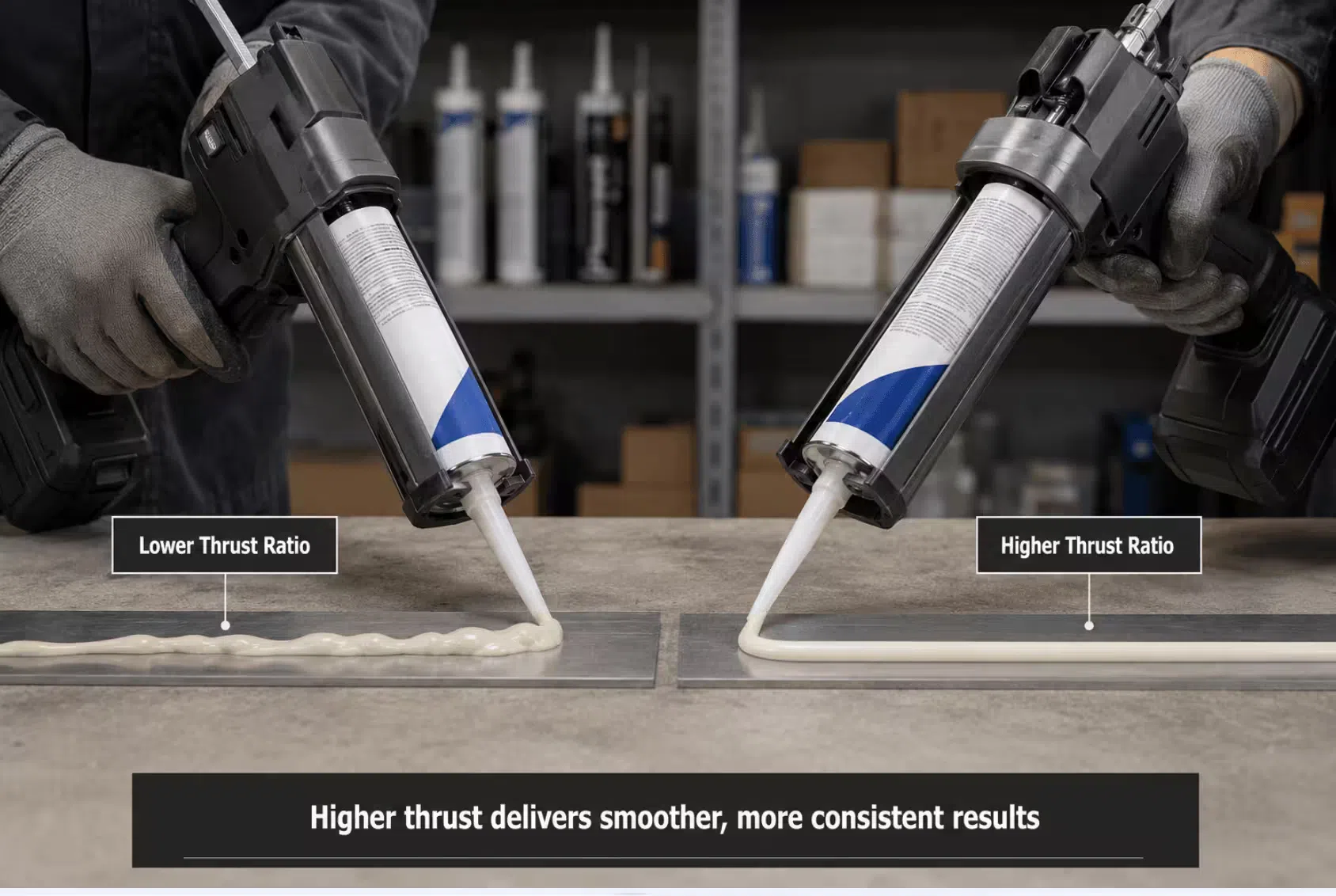
Thrust ratio is the single most important specification for determining whether a caulking gun qualifies as heavy-duty. It measures how much force the gun applies to the cartridge plunger per trigger pull. A 12:1 thrust ratio produces moderate force suitable for thin sealants like silicone. A 26:1 ratio produces significantly more force, which is necessary for dispensing thicker materials like construction adhesive, polyurethane sealant, and butyl caulk.
For cordless models, thrust ratio works together with the motor. A high-thrust caulk gun with a weak motor will stall under load because the motor cannot maintain the mechanical advantage through the gear train. A strong motor with a low thrust ratio will push thin sealants fine but fail on viscous materials.
What to check when sourcing:
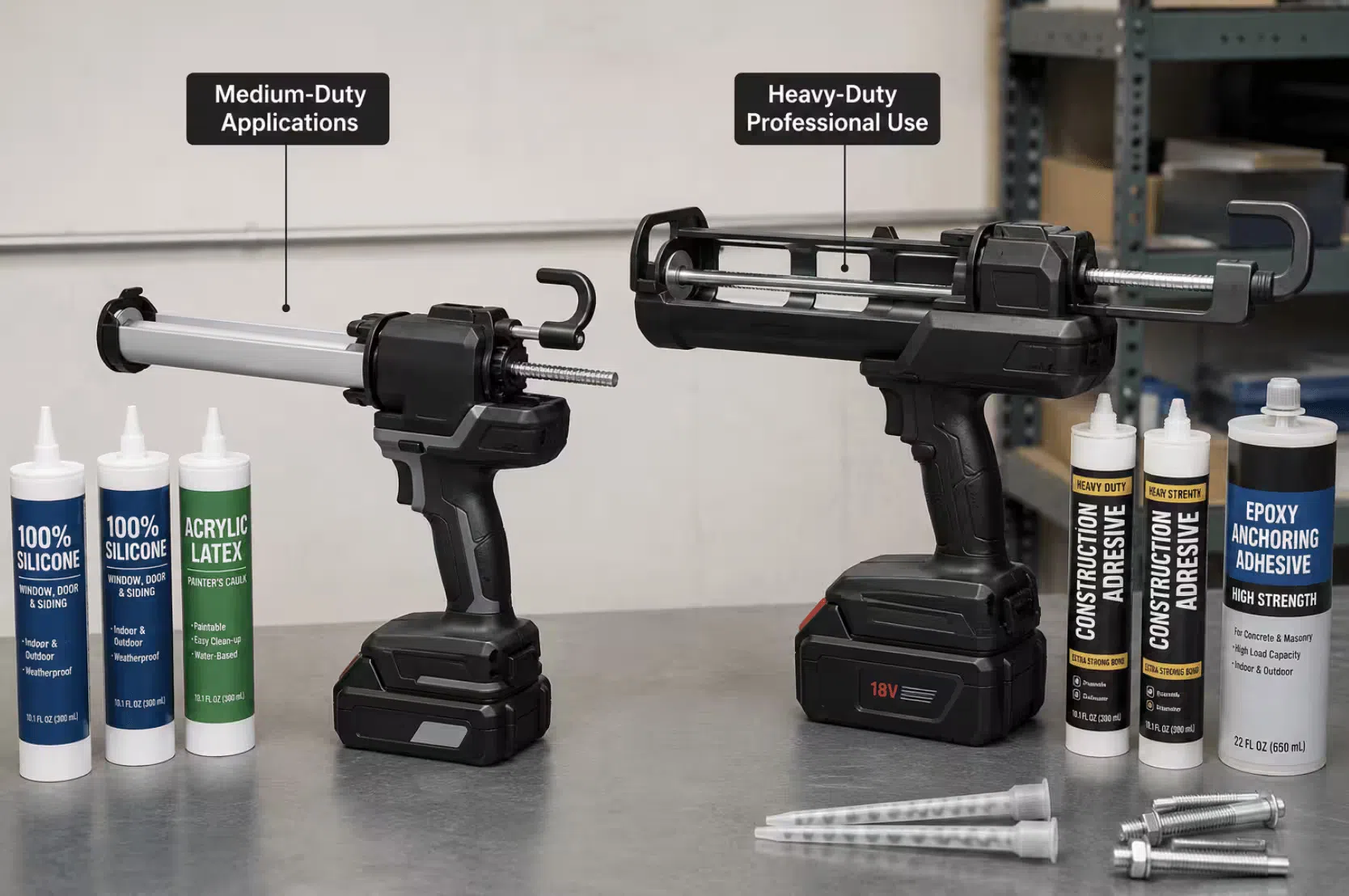
- 12:1 to 14:1 — light-duty. Suitable for silicone, acrylic latex, and other low-viscosity sealants. Fine for interior finishing and light maintenance work.
- 16:1 to 18:1 — medium-duty. Handles most general construction sealants and adhesives. Suitable for window and door installation, exterior caulking, and moderate-frequency use.
- 22:1 to 26:1 — heavy-duty. Required for thick polyurethane, MS polymer, butyl, and construction adhesives. Necessary for contractors dispensing dozens of tubes per day on commercial or industrial job sites.
If your target market includes contractors working with thick sealants, stock models with a thrust ratio of 18:1 or higher. Models below this threshold will not meet professional expectations for heavy-duty dispensing work.
Battery Platform and Runtime for Heavy-Duty Use
Battery voltage and capacity directly affect how long a cordless caulking gun can work before recharging. For heavy-duty professional use, these specs matter more than many buyers realize.
Voltage determines the power ceiling. A 12V platform delivers enough power for intermittent use and thinner sealants. An 18V or 20V platform provides more sustained power for continuous dispensing of thicker materials. In practice, a Milwaukee M12 (12V) model handles daily firestopping work well, while a DeWalt 20V MAX, Makita 18V LXT, or Ryobi ONE+ 18V model is better suited for construction sites with extended dispensing runs and heavier sealant loads.
Battery capacity (Ah) determines runtime. A 2.0Ah battery on an 18V platform may last through a few cartridges of silicone but will drain quickly when pushing thick construction adhesive at high thrust. For heavy-duty use, look for 4.0Ah or 5.0Ah batteries. These add weight but deliver the continuous runtime that professional users need.
Battery compatibility is a practical consideration for B2B buyers. Many professional users already own tools from a specific platform — DeWalt 20V MAX, Milwaukee M18, Makita 18V LXT, or Ryobi ONE+. Stocking a cordless caulking gun that uses the same battery platform reduces the total cost of ownership for end users and makes your product more attractive to existing tool owners.
For wholesale orders, ask your supplier about bare-tool and kit options. Bare-tool models sell well to buyers who already own compatible batteries. Kits with battery and charger are better for first-time cordless caulking gun buyers.
Motor Type and Gear System Durability
The motor and gear system determine how well a cordless caulking gun holds up under sustained professional use. Two specs separate heavy-duty models from standard ones.
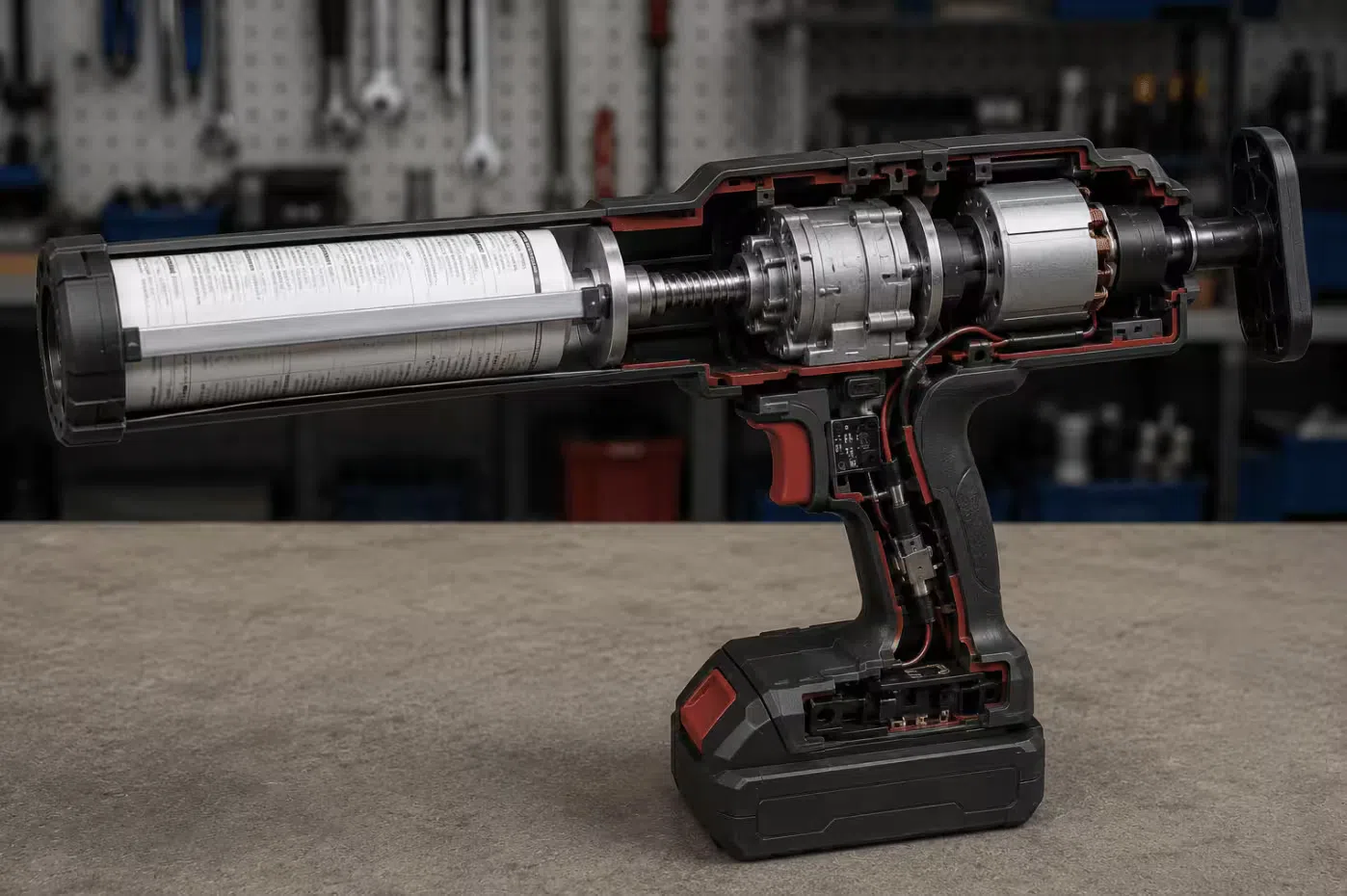
Brushed vs. brushless motor. Brushed motors use carbon brushes that wear down over time, generating more heat and losing efficiency. Brushless motors use electronic commutation, run cooler, last longer, and deliver more consistent torque. For daily professional use, a brushless motor is the better choice. It maintains dispensing force throughout the battery charge and requires less maintenance over the tool's service life.
Gear train material. Under sustained load — dispensing thick sealant cartridge after cartridge — the gear train absorbs significant stress. Metal gears (typically steel or hardened alloy) handle this stress without deforming. Plastic gears may work fine for occasional use but can strip, crack, or wear down under repeated heavy loads. When evaluating a cordless caulking gun model for heavy-duty stocking, ask your supplier whether the gear train is metal or plastic.
Contractors who dispense dozens of tubes per day notice the difference quickly. A model with a brushless motor and metal gears maintains consistent dispensing speed and force from the first tube to the last. A brushed motor with plastic gears may slow down, overheat, or develop play in the trigger after a few months of daily use.
Frame Construction and Build Quality
Frame construction affects both durability and user comfort. For heavy-duty cordless caulking guns, three areas matter.
Housing material. Standard models often use ABS plastic. Professional-grade models use glass-filled nylon, reinforced polymer, or die-cast aluminum. The housing protects the motor and gear train from job site impacts, dust, and moisture. A reinforced housing survives drops and rough handling that would crack a cheaper model.
Barrel and push rod. The barrel holds the cartridge or sausage pack, and the push rod drives the plunger. Steel barrels and rods resist bending and corrosion. On cheaper models, thin or soft-metal rods can bend under high thrust loads, causing uneven dispensing or jamming.
Weight trade-offs. Heavier construction is more durable but increases user fatigue during extended use. A 20V model with a metal housing and 5.0Ah battery may weigh 4 to 5 lbs, compared to 2.5 to 3 lbs for a lightweight 12V model. For construction contractors working a full shift, this difference matters. The right balance depends on the end user's work pattern: heavy construction work tolerates more weight in exchange for durability, while finishing and maintenance work benefits from lighter tools.
When evaluating build quality during sourcing, check the weight specification, ask about housing and barrel materials, and request a sample if possible. Physical inspection reveals build quality differences that specification sheets alone may not capture.
Matching Heavy-Duty Specs to End-User Needs
Different professional users need different combinations of heavy-duty specs. Matching the right model to the right market prevents returns and builds customer loyalty.
Construction contractors dispensing sealant and adhesive on commercial job sites need high thrust ratio (22:1 or above), an 18V or 20V battery platform, a brushless motor, and a durable frame. These users work with thick materials and dispense large volumes daily.
Window and door installers need moderate thrust (16:1 to 18:1), variable speed control, and anti-drip features. Precision matters more than raw power for these applications. A cordless caulking gun with fine speed adjustment helps installers create clean, consistent beads without wasting sealant.
Industrial maintenance teams need reliable runtime, comfortable ergonomics, and compatibility with multiple sealant types. A mid-range 18V model with a 4.0Ah battery and variable speed covers most maintenance sealing tasks without the weight of a full heavy-duty construction model.
Wholesale distributors serving mixed markets should consider stocking at least two tiers: a medium-duty model for general use and a heavy-duty model for construction and industrial buyers. This approach covers the widest range of end-user needs without over-investing in a single specification level.
Frequently Asked Questions
What is a heavy duty caulking gun?
A heavy duty caulking gun is a dispensing tool built with a higher thrust ratio (typically 18:1 or above), a stronger motor, more durable gear train and frame materials, and a larger battery platform than standard models. The term is not regulated, so buyers should check the actual specifications — thrust ratio, motor type, gear material, and battery voltage — rather than relying on the label alone.
Are cordless caulking guns worth it for professional use?
Yes. Cordless caulking guns reduce hand fatigue compared to manual guns, provide consistent dispensing force, and eliminate the need for a compressor or power cord. For contractors and maintenance teams who dispense sealant regularly, the time savings and reduced physical strain justify the investment. The key is matching the model's specs — especially thrust ratio and battery capacity — to the type of sealant and volume of work involved.
What is the best cordless caulking gun for heavy-duty applications?
The best cordless caulking gun for heavy-duty work has a thrust ratio of 22:1 or higher, a brushless motor, metal gear train, 18V or 20V battery platform with at least 4.0Ah capacity, and a reinforced housing. DeWalt, Milwaukee, and Makita all offer professional-grade models. When sourcing for wholesale, compare these specs across models rather than choosing by brand name alone.
What thrust ratio do I need for construction adhesive?
Construction adhesive is thicker than standard sealant and requires a thrust ratio of at least 22:1. Some heavy-duty construction adhesives may require 26:1. If your end users work with polyurethane, MS polymer, or butyl-based products, stock cordless caulking guns with the highest thrust ratio available to avoid stalling and inconsistent dispensing.
Can a cordless caulking gun handle sausage packs?
Many professional-grade cordless caulking guns support both cartridge and sausage pack formats. Some models are convertible with interchangeable barrels or holders. If your target market uses sausage packs — common in commercial glazing and curtain wall installation — confirm that the model supports the sausage format and check the barrel size (typically 20 oz or 600ml). The cordless sausage caulking gun guide on our site covers this topic in more detail.
If you are evaluating cordless caulking guns for your wholesale or OEM program, the specs in this article can serve as a starting checklist. Contact us to discuss which models fit your target market, request specifications, or get a quote for bulk orders.